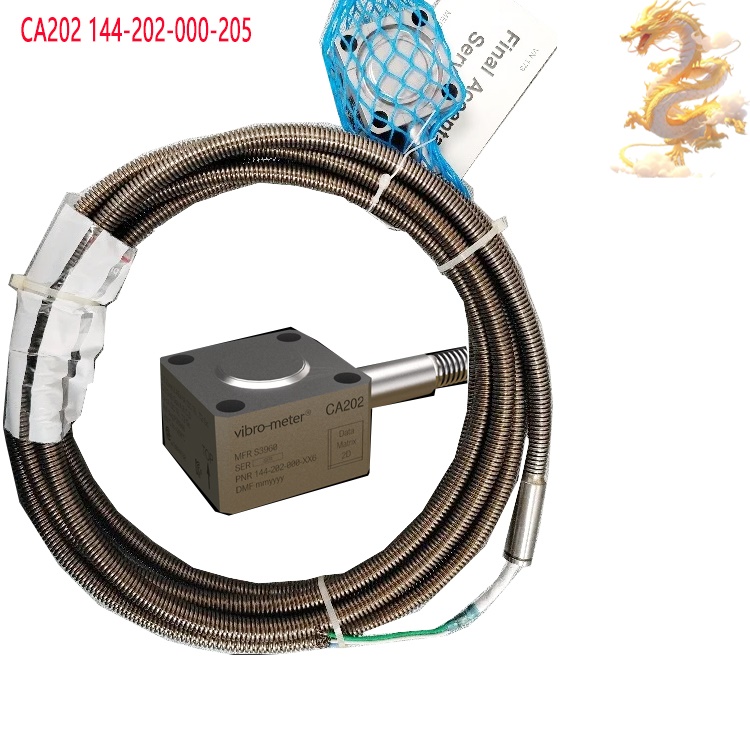
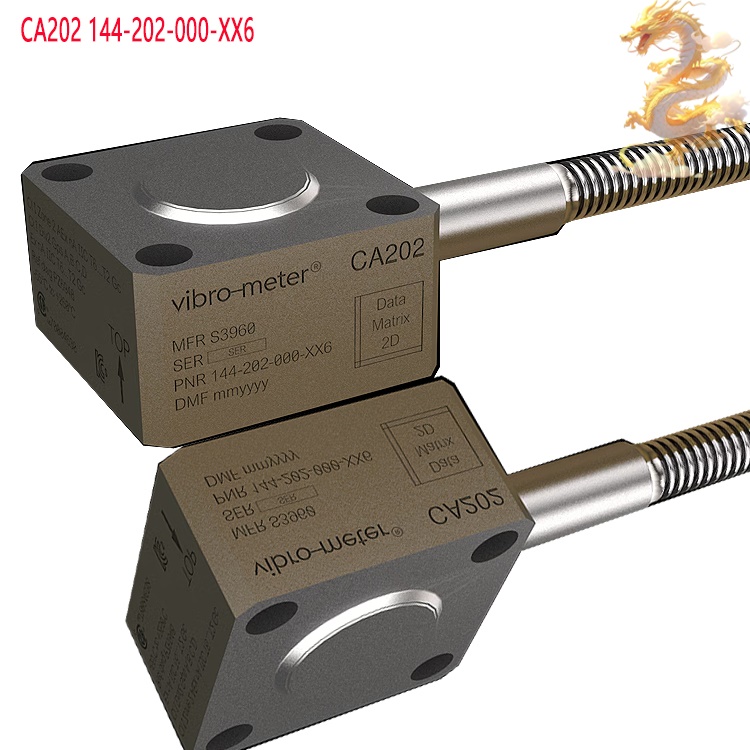
VIBRO-METER piezoelectric accelerometer 144-202-000-511
Employing an airtight welding process and an insulated inner shell design, the entire outer shell is sealed, effectively preventing the intrusion of pollutants such as moisture, dust, and oil, ensuring long-term reliable operation of the sensor in harsh industrial environments. Its core structure consists of an inertial mass, a piezoelectric crystal (typically PZT piezoelectric ceramic or quartz crystal), and a preload spring. When the sensor moves with the object being measured, the inertial mass exerts a force proportional to the acceleration on the piezoelectric crystal due to inertia. The piezoelectric crystal, under this force, generates a charge signal proportional to the force, which is led out through the output terminal. This charge signal is converted by a charge amplifier to obtain a voltage output proportional to the measured acceleration.
.jpg)
Note that all products on this website are special items, and market prices are constantly fluctuating.
Please refer to customer service for a specific quote, as the price may not be accurate for new products.
Please confirm the model, product, price, and other detailed information with customer service before placing an order. This website is currently in use.
New items are available for sale; please contact customer service for further information.
The 144-202-000-511 is a high-performance compression piezoelectric accelerometer from the British brand VIBRO-METER. This sensor is specifically designed for industrial vibration monitoring, featuring high sensitivity, a hermetically sealed welded structure, internal insulation, and an integrated cable. It is widely used in mechanical equipment condition monitoring, structural health monitoring, automotive crash testing, and aerospace vibration testing.
I.
Working Principle
The 144-202-000-511 piezoelectric accelerometer operates based on the piezoelectric effect. Its core structure consists of an inertial mass block, a piezoelectric crystal (usually PZT piezoelectric ceramic or quartz crystal), and a preload spring. When the sensor moves with the object being measured, the inertial mass exerts a force proportional to the acceleration on the piezoelectric crystal due to inertia. The piezoelectric crystal, under this force, generates a charge signal proportional to the force, which is output through the output terminal. This charge signal is converted by a charge amplifier to obtain a voltage output proportional to the measured acceleration.
Essentially, it can be considered a second-order "mass-spring-damping" system. When the frequency of the measured vibration is much lower than the sensor's natural frequency, the amplitude of the output signal is proportional to the acceleration experienced by the base.
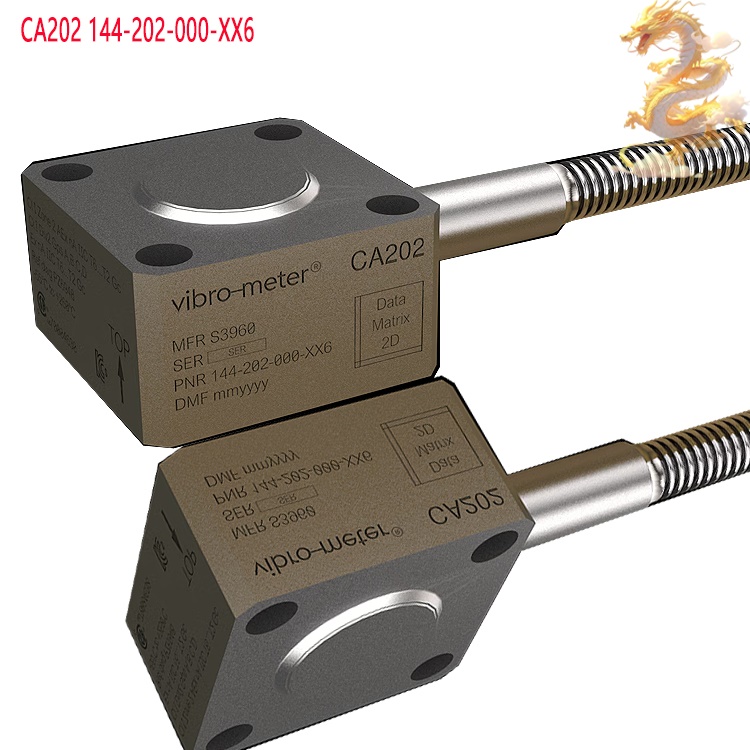
This sensor is a generator-type sensor, requiring no external power supply. However, it lacks true DC response capability and cannot measure constant acceleration or extremely low-frequency signals. Its lower limit frequency can be as low as below 0.3Hz, making it ideal for dynamic vibration and impact measurements.
II.
Product Features
First, high sensitivity. The charge sensitivity reaches 100 pC/g (±5%), enabling precise capture of weak vibration signals, making it particularly suitable for monitoring and analyzing low-level vibrations.
Second, wide temperature adaptability. Operating temperature range: -55℃ to +260℃, enabling stable operation in extreme high or low temperature environments. Suitable for high-temperature conditions in aerospace, metallurgy, petrochemical, and other industries, as well as outdoor monitoring in cold regions.
Third, robust and durable structure. Utilizing airtight welding technology and an insulated inner shell design, the entire outer shell is sealed, effectively preventing the intrusion of contaminants such as moisture, dust, and oil, ensuring long-term reliable operation of the sensor in harsh industrial environments.
Fourth, low lateral sensitivity. Lateral sensitivity is controlled within 3%, effectively suppressing interference from vibrations perpendicular to the main sensing axis, ensuring the accuracy of measurement results.
Fifth, high impact resistance. Impact limit up to 1000g, overload limit 500g, capable of withstanding strong mechanical impacts without damage, suitable for high-impact scenarios such as drop tests and collision tests.
.jpg)
Sixth, integrated cable design. The sensor is shipped with an integrated low-noise cable, reducing signal attenuation and noise introduction caused by field wiring, improving the signal-to-noise ratio of the measurement system.
III.
Frequency Response Characteristics
The upper limit of the usable frequency of this sensor is determined by its resonant frequency of 20 kHz. Based on engineering experience:
When the operating frequency is 1/3 of the resonant frequency (approximately 6.7 kHz), the amplitude error is less than 1 dB (approximately 10%);
When the operating frequency is 1/5 of the resonant frequency (approximately 4 kHz), the amplitude error is less than 0.5 dB (approximately 5%).
The lower frequency limit is limited by the low-frequency cutoff frequency of the subsequent charge amplifier. With a high-quality charge amplifier, it can be as low as 0.3 Hz or even lower, but this sensor does not have true DC response capability and cannot measure constant acceleration (such as gravitational acceleration).
IV.
Structural Form
The 144-202-000-511 adopts a central compression structure. The piezoelectric element-mass block-spring system is mounted on a circular central support, and the entire assembly is sealed within a thick-base metal housing. A preload spring applies a preload force to the mass block, ensuring the piezoelectric crystal is always under pressure.
The advantages of the compression structure are high rigidity, high resonant frequency, and wide frequency response range. However, it should be noted that this structure is sensitive to base strain and temperature changes. During installation, ensure the mounting surface is flat and smooth, and apply silicone grease to increase contact rigidity.
V.
Installation and Usage Precautions
Installation Method: Rigid connection with steel bolts is recommended. The installation torque is approximately 3 N·m, and the surface roughness should be less than 3 μm. Adhesive bonding (epoxy resin), mica sheet thermal insulation, or magnetic bases can also be used, but different installation methods will reduce the upper limit of usable frequencies to varying degrees.
Cable Requirements: Low-noise coaxial cable (such as RG178/U) must be used. Cable length affects the output signal; the charge amplifier should have output characteristics independent of cable length.
Supporting Instruments: Because this sensor is a high-impedance charge output type (PE type), it must be used with a charge amplifier with high input impedance (≥2000 MΩ). It cannot be directly connected to a standard voltmeter.
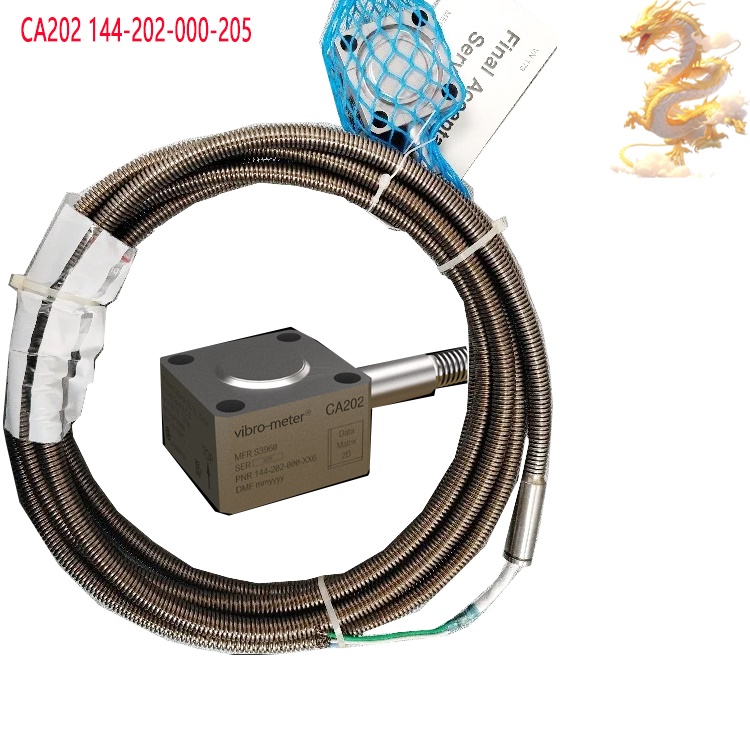
Operating Environment: Although the operating temperature range is wide (-55°C ~ +260°C), when used in humid or liquid environments, the wiring connector must be sealed to ensure good insulation.
Measurement Limitations: It cannot measure static (zero-frequency) acceleration; in high-impact environments, the impact limit must not exceed 1000g.
VI.
Typical Application Areas:
This sensor is mainly used in the following areas: vibration monitoring and fault diagnosis of industrial rotating machinery (such as motors, pumps, compressors, turbines, etc.); health monitoring of large structures (such as bridges, buildings, wind turbines, etc.); automotive crash testing and packaging transportation impact testing; vibration monitoring and health use monitoring systems (HUMS) for aerospace equipment; environmental stress screening tests; and vibration and shock measurements in scientific research laboratories.
VII.
Summary
The 144-202-000-511 piezoelectric accelerometer is a classic high-sensitivity compression piezoelectric accelerometer. With its high sensitivity of 100 pC/g, high resonant frequency of 20 kHz, wide operating temperature range of -55°C to +260°C, and low lateral sensitivity of ≤3%, it is a reliable choice for industrial vibration monitoring and dynamic measurement. When using it, it is essential to use a charge amplifier and pay attention to the correct installation method to fully utilize its excellent measurement performance.
Many products are not yet listed. Please
contact us for more products.
If the product model does not match the displayed image, the model number shall prevail. Please contact us for specific product images; we will arrange to take photos in our warehouse for confirmation.
We have 76 shared warehouses worldwide, so it may sometimes take several hours to accurately return the information to you. We apologize for the inconvenience. Of course, we will respond to your inquiries as soon as possible.
Recommended
related products:
144-202-000-305
Vibro-Meter
144-202-000-303
Vibro-Meter
144-202-000-136
Vibro-Meter
144-202-000-135
Vibro-Meter
144-202-000-126
Vibro-Meter
144-202-000-125
Vibro-Meter
144-202-000-116
Vibro-Meter
144-202-000-115
Vibro-Meter
144-202-000-106
Vibro-Meter
144-202-000-105
Vibro-Meter
144-202-000-104
Vibro-Meter
144-202-000-103
Vibro-Meter
Vibro-Meter
144-134-000-203
More......
PRODUCT TAGS
RELATED PRODUCTS
PLC Dragon Automation
Address: Wanda Plaza, Chengdu, Sichuan Province
Google email: wkcarshop666888@gmail.com
Industrial Control Sales Consultant: Amelia
Whatsapp: +86 18030295882
12A3256BC9DA41BAB264DB676273DA32.png)


3BE7E049824E4F11BE61AD65D86DFEBD.png)